ARCHIMEDES’ PRINCIPLE
The Science Behind Floating Ships
Understanding Archimedes’ Principle

Why does a massive steel ship weighing thousands of tonnes float on water, while a small piece of steel sinks almost immediately? The answer lies in one of the fundamental principles of physics: Archimedes’ Principle. This scientific concept explains buoyancy, the upward force exerted by a fluid on an object immersed in it, and plays a crucial role in understanding how ships float and remain supported by water.
Archimedes’ Principle is named after the ancient Greek mathematician and scientist Archimedes of Syracuse. According to the principle, an object wholly or partially immersed in a fluid experiences an upward buoyant force equal to the weight of the fluid displaced by that object. This means that when an object enters water, it pushes aside a certain volume of water, and the displaced water produces an upward force acting on the object.
Understanding Buoyant Force
Buoyant force is the upward force exerted by a fluid against the weight of an immersed object. It occurs because fluid pressure increases with depth. The lower surfaces of an immersed object experience greater pressure than its upper surfaces, resulting in a net upward force.
The magnitude of this force depends on the density of the fluid, the volume of fluid displaced and gravitational acceleration. It can be expressed mathematically as:
Where:
\(F_B\) = Buoyant force (Newtons)
\(\rho\) = Density of the fluid (kg/m³)
\(g\) = Acceleration due to gravity (m/s²)
\(V\) = Volume of fluid displaced (m³)
For example, an object displacing one cubic metre of freshwater displaces approximately 1,000 kilograms of water. The resulting buoyant force is approximately 9,810 Newtons under standard gravitational conditions.
Why Do Ships Float?
A ship is constructed mainly from steel, which is denser than water. However, a ship does not behave like a solid block of steel. Its hull is designed with a large hollow internal volume containing air and other spaces. This allows the vessel to displace a substantial quantity of water without having to submerge completely.
As a ship enters the water, it displaces water until the upward buoyant force balances its total weight. At this point, the vessel achieves floating equilibrium. The amount of water displaced is therefore directly related to the vessel's weight.
This explains why even enormous container ships, oil tankers and passenger vessels can float safely. Their hull designs allow them to displace enough water to generate the buoyant force required to support their weight. The shape and volume of the underwater hull are therefore essential considerations in ship design.
The Relationship Between Weight and Displacement
For a floating vessel in equilibrium, the weight of the displaced water is equal to the total weight of the ship. This relationship is fundamental to naval architecture and is used when calculating a vessel's displacement.
When cargo, fuel, freshwater or stores are loaded onto a vessel, its total weight increases. The ship must displace additional water to generate an equal upward buoyant force, causing it to sink slightly deeper into the water. Conversely, when cargo is discharged or fuel is consumed, the vessel's displacement decreases and it generally rises higher in the water.
This relationship is important when determining loading conditions, draft, freeboard and compliance with the vessel's approved loading limitations.
Applying the Principle in Maritime Engineering
Ship Stability and Buoyancy

Archimedes’ Principle is closely connected to ship stability, which determines a vessel's ability to remain upright and return to its original position after being disturbed by external forces such as wind and waves.
Two important points are considered when studying a floating vessel: the centre of gravity (G) and the centre of buoyancy (B). The centre of gravity is the point through which the vessel's total weight acts vertically downward. The centre of buoyancy is the centre of the underwater volume displaced by the vessel, through which the buoyant force acts vertically upward.
When a vessel heels, its underwater shape changes, causing the centre of buoyancy to shift. The relationship between the centre of gravity, centre of buoyancy and metacentre helps determine the vessel's initial stability. The distance between the centre of gravity and metacentre is known as the metacentric height (GM), an important measure used in assessing initial stability.
Understanding these principles allows naval architects and marine engineers to design vessels with suitable stability characteristics for their intended operations.
The Importance of Water Density
The buoyant force acting on a vessel is also influenced by the density of the surrounding water. Seawater is generally denser than freshwater because of its dissolved salts. As a result, a vessel displaces less volume of seawater than freshwater when supporting the same weight.
This explains why ships generally float slightly deeper in freshwater than in seawater. The difference is particularly important when vessels travel between rivers, inland waterways, ports and open oceans.
Seafarers must understand these variations when monitoring draft and loading conditions. The water density of a particular port or waterway can influence how much cargo a vessel can safely carry within its permitted loading limits.
Practical Applications Onboard Ships
Archimedes’ Principle has several practical applications in everyday maritime operations. Ship loading calculations use displacement to determine how much weight a vessel can carry under specified conditions. Draft surveys help estimate cargo quantities by measuring changes in the vessel's draft before and after loading or discharge.
Ballast systems also rely on the relationship between displacement and buoyancy. By taking in or discharging ballast water, vessels can adjust their draft, trim and stability according to operational requirements. Submarines use the same fundamental principle through their ballast tanks: taking in water increases their overall average density and allows them to descend, while expelling water helps them rise.
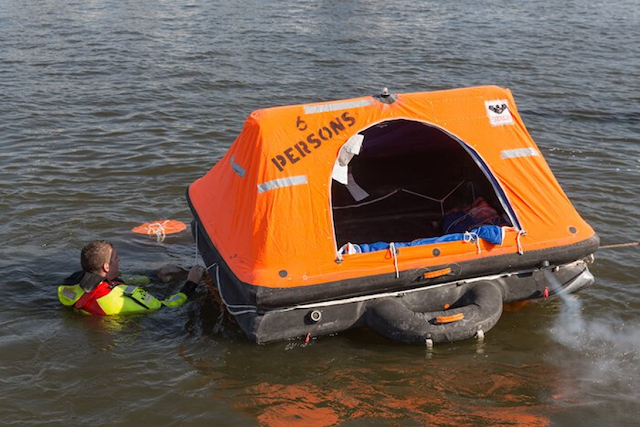
The principle is also relevant to lifeboats, life rafts, floating platforms and other marine structures. Their design must provide sufficient buoyancy to support the intended load while maintaining appropriate safety margins.
A Fundamental Principle Behind Modern Shipping

Although Archimedes’ Principle was established centuries ago, it remains one of the foundations of modern maritime engineering. From the design of enormous commercial vessels to the operation of small lifeboats, the science of buoyancy influences almost every aspect of floating structures.
For maritime students and aspiring seafarers, understanding this principle provides a strong foundation for studying ship construction, hydrostatics, stability, loading and cargo operations. It also helps explain why draft, displacement, water density and loading conditions must be monitored throughout a voyage.
The ability of a ship to float is not simply a result of its size or construction material. It is the result of a precise balance between weight and the buoyant force generated by displaced water. Archimedes’ Principle continues to guide the science and engineering that keep ships afloat and the maritime industry moving.

Comments
Post a Comment